

Childcare fees can be confusing. This article walks you through how the Child Care Subsidy is applied in practice — with the 2026 CCS hourly rate cap and the 3-Day Guarantee explained in clear, simple language.
Childcare fees are one of the larger household costs a young family will take on, and working out the actual out-of-pocket amount can feel complicated. The Child Care Subsidy, the hourly rate cap and the 3-Day Guarantee all interact — and the effect varies from family to family.
This article walks through an illustrative example so you can see, step by step, how the Child Care Subsidy is calculated and roughly what the weekly out-of-pocket amount might look like for a family in a given income band. Please treat the figures as a guide only. Your actual entitlement is determined by Services Australia, and the exact amount at any centre depends on its daily fee and session length.
We will cover the 2025–2026 Child Care Subsidy rates, the 3-Day Guarantee that came in on 5 January 2026, and the question families most often ask us: roughly what would the weekly out-of-pocket amount look like?
Let’s start with an example family.

Montessori Minds Childcare & Kindergarten — our purpose-built centre at 25 Princes Highway, Norlane.
01 /Meet an example Geelong family
To make the CCS maths concrete, we will use an illustrative example. Consider the James family, who live in Bell Post Hill. Alex works four days a week as an engineer. Sophie works full-time as a nurse. Their combined (two-income) adjusted taxable family income is $135,000 per year. They have one child — Peter, aged 2½ — and are looking at a three-day-a-week placement (Tuesday, Wednesday, Thursday) starting in May 2026.
The James family is an illustrative example, not a specific family. If your household earns more or less than $135,000, or if yours is a single-income household, you can adjust the figures proportionally as we go — and we will show you exactly how.
Here is what a family in this situation needs to work out:
- What is the daily fee at Montessori Minds?
- What CCS percentage will the family qualify for?
- How many subsidised hours can they claim each fortnight under the 3-Day Guarantee?
- What is the out-of-pocket cost per day and per week?
We’ll work through each one.
02 /The daily fee at Montessori Minds
Our indicative 2026 daily fee is $146 per day for all age groups (Babies, Toddlers and Kindergarten). The standard session is 10 hours (8:00am–6:00pm). That is the fee we will use throughout this worked example.
Included in the daily fee: a freshly prepared 3-course meal (morning tea, lunch and afternoon tea), nappies for children who need them, and a full program of curriculum activities — including art, music, science, gardening, cultural studies and outdoor play. You can read more about what a day looks like in our Kindergarten program.
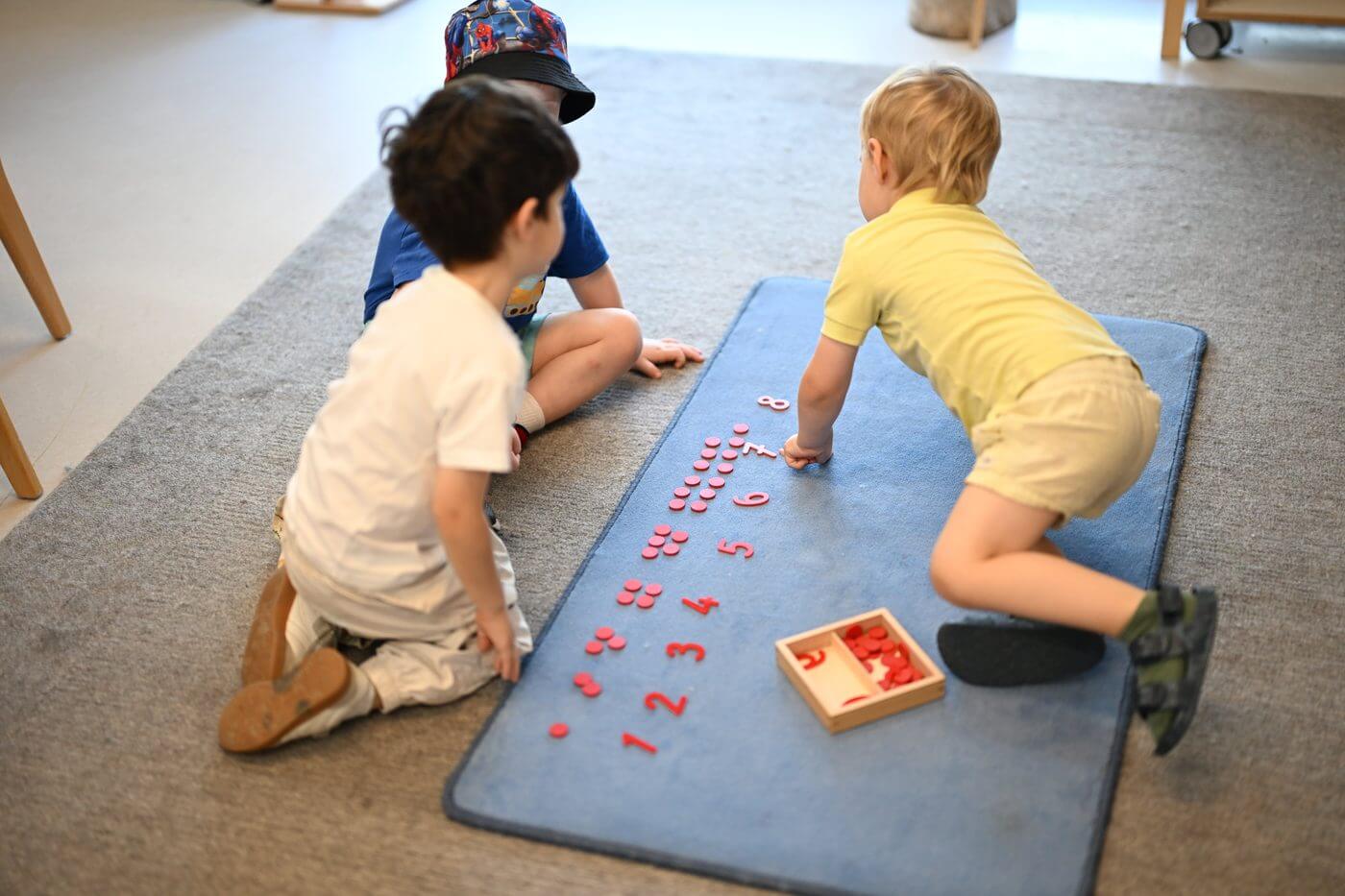
Children working with cards and counters — a Montessori numeracy activity that builds number recognition and quantity association. One of many curriculum activities included in the daily fee.
Once the Child Care Subsidy is applied — which is the focus of this article — out-of-pocket costs can look quite different from the daily fee alone. The worked example below shows how.
“The headline daily fee is only part of the picture. What a family budgets for is the out-of-pocket amount after CCS — and that depends on their individual circumstances.”
— Montessori Minds
— Montessori Minds
03 /Working out the James family’s CCS percentage
The Child Care Subsidy is calculated on your combined adjusted taxable family income — that is, the total of both parents’ (or a single parent’s) taxable income. For the 2025–2026 financial year, the rules are:
- Families earning under $85,279 receive the maximum 90% subsidy.
- The subsidy rate then reduces by 1% for every additional $5,000 of combined family income.
- Families earning $535,279 or more receive 0% CCS.
The James family’s combined income is $135,000. That’s $49,721 over the $85,279 threshold, which is roughly 10 increments of $5,000. So their CCS percentage is approximately 90% − 10% = 80%.
A note on precision
Always confirm with the official calculator
The 1% reductions apply per full $5,000 increment, and the final percentage can shift by 1–2% depending on rounding. For an exact figure, use the official Starting Blocks CCS calculator. The worked example below uses 80% as a conservative estimate.
04 /How the hourly rate cap applies
This step often catches families by surprise. The government does not subsidise your daily fee directly — it subsidises an hourly rate, capped at $14.63 per hour for Centre-Based Day Care for children below school age (2025–2026 financial year).
Our daily fee is $146 for a 10-hour session (8am–6pm). That gives an effective hourly fee of $146 ÷ 10 = $14.60 per hour.
Because our effective hourly rate sits just below the $14.63 cap, the government subsidises 80% of our actual hourly fee — not the cap. This means the CCS calculation is straightforward: 80% of $146 is subsidised, and the family pays the rest.
When comparing centres, it is always worth asking about the effective hourly rate (daily fee ÷ session length) and how it compares to the $14.63 cap. If a centre’s hourly rate sits above the cap, the amount above the cap is not subsidised — families pay the difference out of pocket. The calculation below shows how this works in practice.
05 /The James family’s weekly out-of-pocket cost
Now we put it all together. Three days a week, 10 hours per day (8am–6pm), at a daily fee of $146, with an 80% CCS subsidy applied:
Worked example · The James family
3 days per week, 2026
Daily fee (8am–6pm)$146.00
Session length10 hours
Effective hourly fee$14.60
CCS hourly rate cap (2025–2026)$14.63
James family CCS rate (combined $135k income)80%
CCS subsidy per day (80% × $146)$116.80
Out-of-pocket per day$29.20
Weekly cost (3 days)$87.60
That’s approximately $87.60 per week out of pocket for three full days of early learning in a purpose-built Montessori centre, with qualified educators and a curriculum delivered in line with the Early Years Learning Framework.
Put another way: that works out to around $2.92 per hour out of pocket for a full 10-hour day of care, learning and support. Your exact out-of-pocket amount depends on your family’s income and Services Australia’s assessment.
Run your own numbers
Want an honest estimate for your family’s income and preferred days?
Book a tour and our team can walk you through the fee structure, your likely CCS entitlement, and the steps to enrol. We’ll answer your questions openly, and there’s no pressure to decide on the day.
06 /The 3-Day Guarantee — and why it matters from January 2026
One of the most significant changes to CCS came into effect on 5 January 2026. It’s called the 3-Day Guarantee, and it dramatically changes the calculation for many families — especially those where one parent works part-time, studies, or has a fluctuating work pattern.
Before January 2026, the amount of subsidised care you could access depended on an “activity test”. Parents had to demonstrate a combined minimum of work, study or volunteering hours each fortnight to qualify for 72+ hours of subsidy. Below certain thresholds, families were capped at 36 hours or even 24 hours of subsidised care per fortnight — often making three days a week unaffordable.
From 5 January 2026, that has changed. All CCS-eligible families now receive a minimum of 72 hours of subsidised care per fortnight — roughly three days a week — regardless of how many activity hours each parent records. Families who meet higher activity thresholds (more than 48 hours per fortnight between both parents) can still access up to 100 hours.
In practice, this means the James family is comfortably covered. Sophie’s full-time nursing shifts and Alex’s four-day engineering work push them well into the higher-activity band. Their three-day-a-week booking at Montessori Minds (30 hours per week, or 60 hours per fortnight) is fully within their subsidised entitlement.
But the change matters even more for families where, for example, one parent has stepped back from work for a year — or where a parent is studying part-time. Under the old rules, those families often couldn’t justify a third day. Under the 3-Day Guarantee, they can.
Coming soon
Looking for Kindergarten fees? We cover that separately.
Victorian Free Kinder funding changes the maths again for 3 and 4-year-olds — and deserves its own walkthrough. We’ll cover how Free Kinder interacts with CCS, what it means for families at different income levels, and the eligibility criteria, in a dedicated article: Victorian Free Kinder at a Montessori Centre — What Geelong Families Need to Know. For now, see our Kindergarten program page for an overview of how our 3–5 year program runs.
07 /Two things worth double-checking
When families are working out childcare costs, two points often come up that are worth flagging here.
Comparing headline daily fees instead of out-of-pocket fees
The headline daily fee is only part of the picture. Two centres with different daily fees can produce different out-of-pocket costs depending on their session length, their effective hourly rate, and where that rate sits relative to the $14.63 cap. When comparing centres, it can help to ask about: (1) the daily fee, (2) the session length in hours, (3) the effective hourly rate, and (4) how that compares to the cap.
Keeping your family income estimate up to date in myGov
Your CCS is calculated on the income estimate you provide to Services Australia. If your income changes during the year — a promotion, a return to full-time work, a partner changing jobs — updating your estimate in myGov helps keep your subsidy accurate. Under-estimating can create a debt at year-end balancing; over-estimating means you pay more out of pocket during the year than you need to. It’s worth reviewing periodically, and we’re happy to explain it when you visit.
08 /A note on how we share fee information
We prefer to walk through fees with families in person rather than send a fee schedule in advance. Not because we’re being cautious about pricing — the opposite. A daily-fee figure without the context of your child’s session pattern and your family’s income estimate can be difficult to interpret on its own. Sitting down together lets us explain how the numbers apply to your family’s specific circumstances.
We also recognise that cost is an important factor for many families, and that price points vary across the Geelong region — from Norlane and Corio through to Lara, North Geelong and Bell Park. Every family weighs cost alongside other factors — location, hours, program, environment, educators, inclusion — and the right centre for your family is the one that fits your priorities. We encourage families to tour several centres and ask clear questions at each one.
What we can say honestly is this: for families looking for a Montessori-informed curriculum delivered in a purpose-built centre, the out-of-pocket gap after CCS is often smaller than the difference in headline daily fees suggests. We’d welcome the chance to walk you through the figures for your situation.
Important — please read: This article is provided for general information only. All figures shown are illustrative estimates based on publicly available 2025–2026 Child Care Subsidy rates as at April 2026. The example family (the James family) is hypothetical and used only to demonstrate how CCS is calculated. Your actual Child Care Subsidy entitlement is determined solely by Services Australia based on your family’s individual circumstances. Daily fees are indicative and subject to change; current fees will be confirmed at tour and in your enrolment paperwork. Inclusions (such as meals and nappies) may vary, and current details are confirmed at tour. For an official CCS estimate, please use the Starting Blocks CCS calculator or contact Services Australia directly. For a Montessori Minds-specific fee discussion, please get in touch. Nothing in this article constitutes financial, legal or taxation advice.
09 /Frequently asked questions
What is the CCS hourly rate cap in 2026?
For Centre-Based Day Care, the cap is $14.63 per hour for children below school age for the 2025–2026 financial year. The government subsidises a percentage of whichever is lower — your centre’s actual hourly fee or the cap.
How is the 3-Day Guarantee different from the old activity test?
Before 5 January 2026, families had to meet an activity test (work, study or volunteering hours) to qualify for more than 36 subsidised hours per fortnight. From January 2026, all CCS-eligible families receive a minimum of 72 hours per fortnight automatically, regardless of activity level. Families meeting higher activity thresholds can still access up to 100 hours.
How do I work out my family’s specific CCS amount?
Use the official Starting Blocks CCS calculator for a personalised estimate. You’re also welcome to book a tour — we can walk you through the figures that apply to your family’s situation.
What if my income changes during the year?
Update your family income estimate in myGov as soon as your circumstances change. Under-estimating can result in a debt at end-of-year balancing; over-estimating means you pay more out of pocket during the year than you need to.
Does the 3-Day Guarantee apply if I’m not working?
Yes. From 5 January 2026, all CCS-eligible families receive a minimum of 72 hours of subsidised care per fortnight regardless of work or study hours. Higher subsidised hours (up to 100) are available for families with more than 48 activity hours per fortnight.