

Mathematics
What is the Mathematics area?
Dr Maria Montessori observed that young children have what she described as a "mathematical mind" — a natural interest in order, sequence, precision and pattern that can be seen from an early age in everyday play. Building on this observation, and on the groundwork laid in the Sensorial area, Mathematics materials are designed to make abstract number concepts concrete and visible.
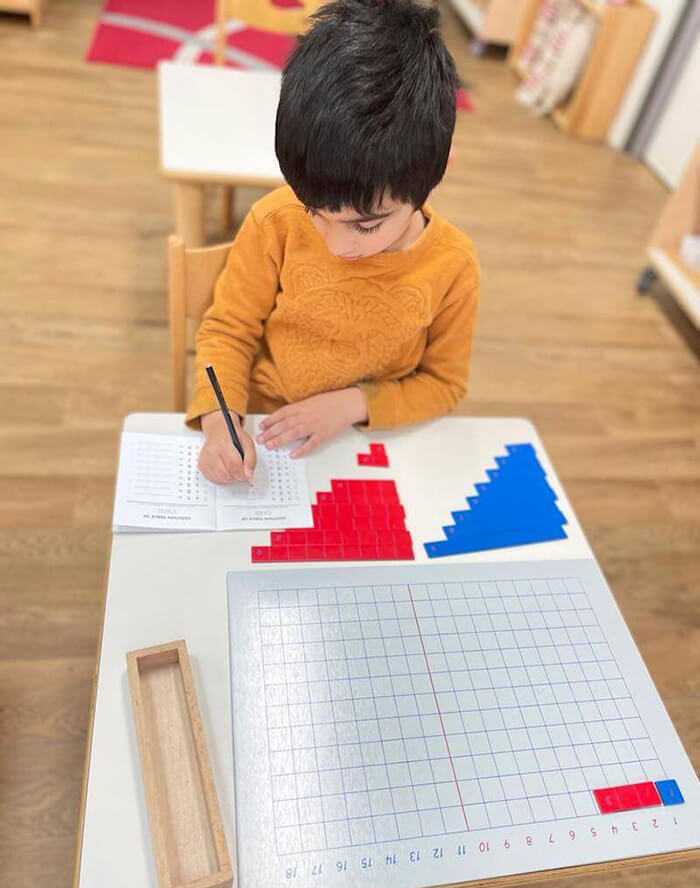
Children typically begin by handling real, countable quantities — such as rods, beads or counters — alongside the printed numeral. Over time, and at each child's own pace, materials are introduced that support the gradual move from concrete quantity towards more abstract number work, including early operations such as addition, subtraction, multiplication and division.
At a glance
Why we place such value on it
Mathematics materials build on the sensory discrimination and sense of order that children develop in the Sensorial area, offering a bridge between hands-on exploration and symbolic, abstract thinking. Many materials also include a built-in "control of error," meaning a child can often notice a mismatch and self-correct, without needing an adult to point it out.
Broadly, this area of the curriculum is associated with:
- Connecting a physical quantity with its printed numeral, supporting an early, concrete understanding of number
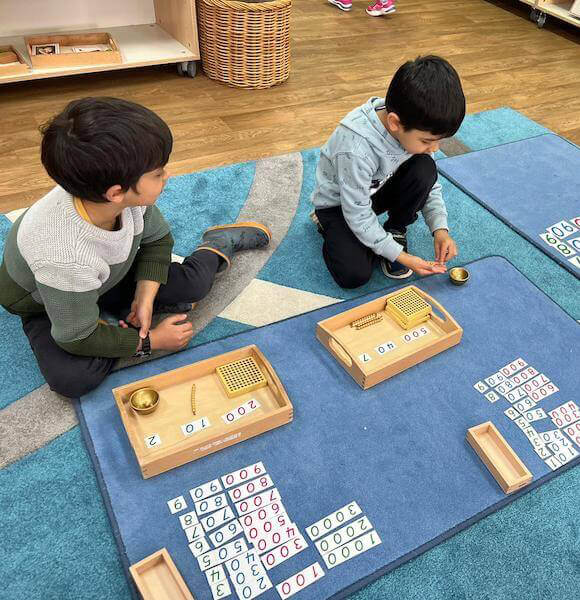
- Introducing the base-ten (decimal) system through materials that represent units, tens, hundreds and thousands
- Building familiarity with counting sequences and simple patterns through repetition and hands-on practice
- Offering an early, concrete introduction to operations such as addition, subtraction, multiplication and division
- Encouraging concentration, precision and independent, self-corrected exploration
Groups of materials in this area
Materials children may explore
Within a prepared Mathematics environment, materials are offered in a logical sequence, from simple to more complex, and are introduced in line with each child's stage of development and demonstrated readiness. Examples may include:
- Number Rods and Sandpaper Numerals, for connecting quantity and symbol
- Spindle Boxes and Cards and Counters, for practising counting and recognising odd and even quantities
- Golden Bead material, for a concrete introduction to the decimal system
- Bead stairs and number chains, for counting sequences and skip counting
- The Stamp Game, for early, hands-on practice with number operations
- Fraction insets and circles, for exploring a whole divided into equal parts
Part of a quality-assured program
- Educational program & practice
- Children's health & safety
- Physical environment
- Relationships with children
- Collaborative partnerships with families