
Language
What is the Language area?
Dr Maria Montessori observed that oral language lays the foundation for all later reading and writing, and that young children move through a sensitive period for language during which many tend to absorb the sounds, vocabulary and patterns of the language, or languages, spoken around them with particular ease.
In our program, language learning is understood as a gradual progression — generally beginning with oral language and vocabulary, moving toward an awareness of phonetic sounds, and extending over time into written symbols, words and simple sentences. The age at which each child moves through this progression, and the pace at which they do so, varies from child to child.
At a glance
Oral language lays the foundation to all writing and reading!
Oral Language
|
Names of
|
| 3 Practical Life of all sensorial materials |
| Classified cards (NO words) |
| Oral definitions |
| Given with classified cards, |
| When working with Practical Life materials, working with land and water forms |
| Conversations with pictures, including continent/Geology folders and land and water form folders |
| Oral preparation for function of word games |
| Oral preparation for word study |
| Question game |
Reading
|
Handwritten then introduction to preparatory labels
|
| Language of the sensorial materials |
| 3-part cards (know the picture, read the label, check with the control card) |
| Definition booklets |
| Then definition reading in 3 stages |
| Sentences under pictures, on the backs of cards in folders |
| Function of word games |
| Word study |
| Reading/Sentence analysis |
Why we place such value on it
Dr Montessori described a sensitive period for language from birth to around six years of age, during which many children show a strong interest in absorbing the sounds, vocabulary and structure of the language spoken around them. She also observed that many children build a strong foundation in their first language, or mother tongue, by around three years of age — though, as with all areas of development, the age and pace at which this occurs will vary from child to child and cannot be guaranteed.
Broadly, this area of the curriculum is associated with:
- Building vocabulary through everyday naming, conversation and exposure to new words
- Supporting listening skills and an emerging awareness of the sounds within words
- Preparing children for reading through hands-on, sequential materials
- Encouraging early written expression as each child shows readiness
- Connecting language with other curriculum areas, such as culture and sensorial exploration
Areas of language explored in our program
Activities children may explore
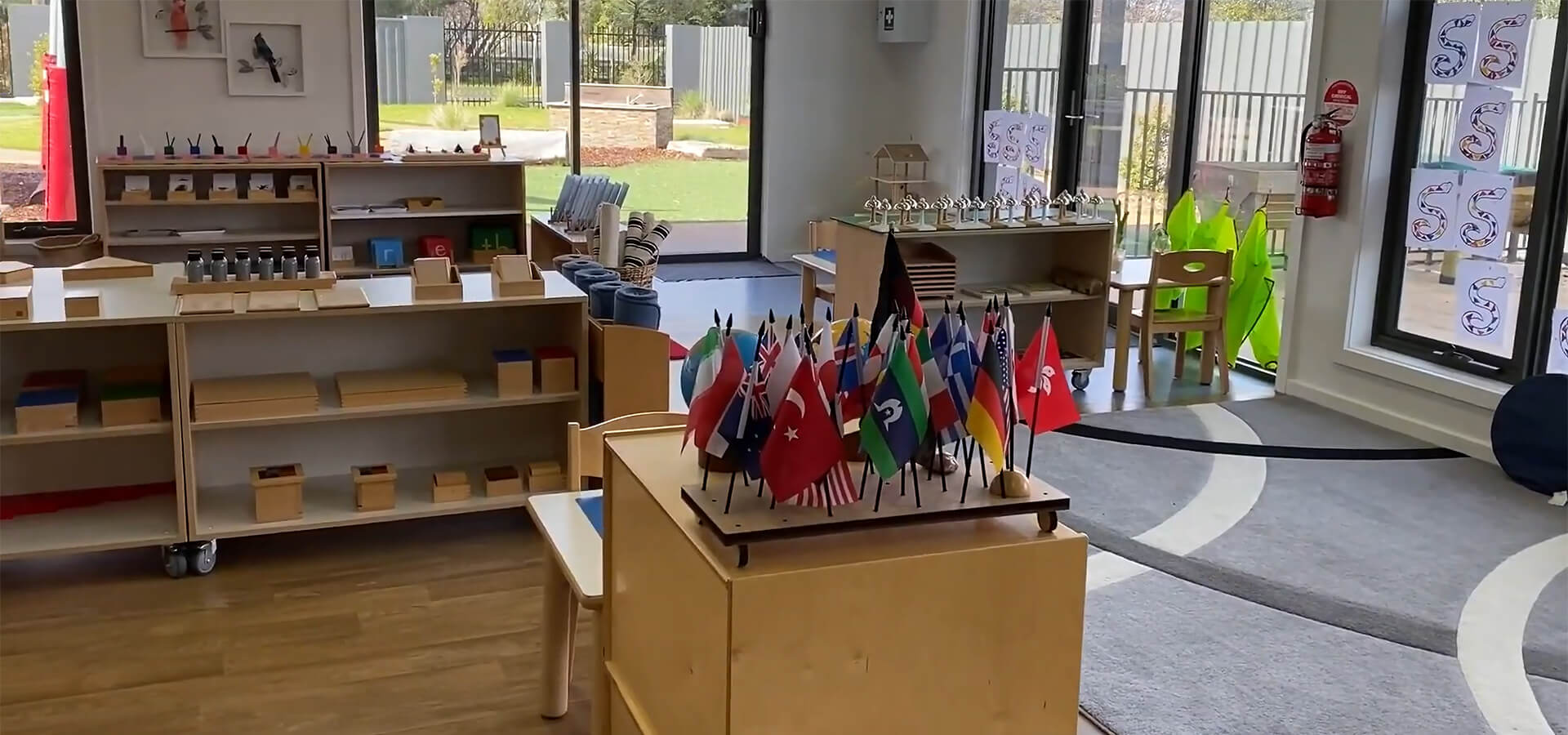
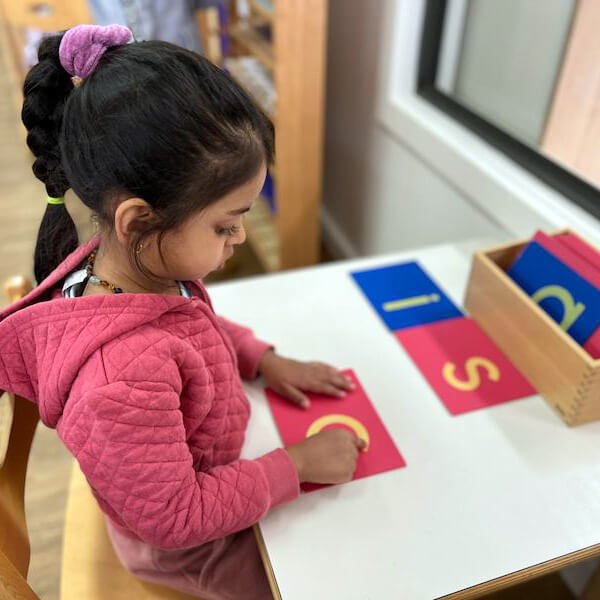
Within our prepared Language environment, activities are offered in a logical sequence, from simple to more complex, and are adapted to suit each child's stage of development. Examples may include:
- Naming and vocabulary activities using items in the environment, alongside picture materials such as geography and geology folders
- Conversation, question games and rhyming activities
- Singing, rhymes and poems as part of everyday oral language
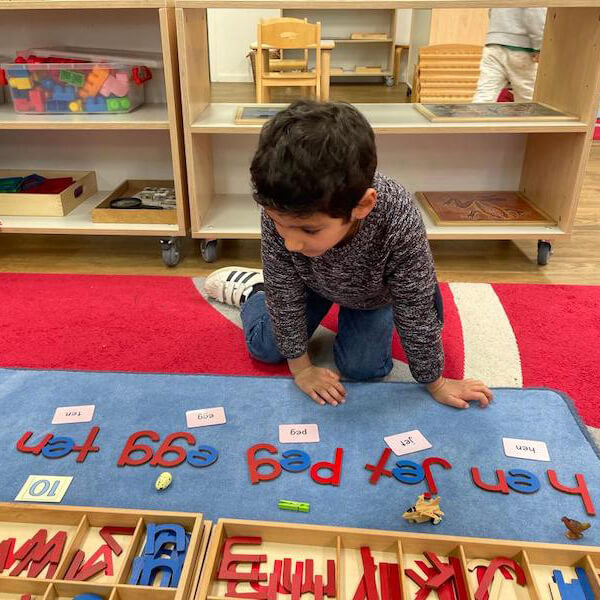
- Handwritten and preparatory labels, introduced alongside classified picture cards
- Three-part cards, used to support picture recognition, label reading and self-checking with a control card
- Definition booklets and reading activities introduced in stages
- Sentence analysis and word study games, including activities exploring the function of words
Part of a quality-assured program
- Educational program & practice
- Relationships with children
- Communication & literacy development
- Collaborative partnerships with families